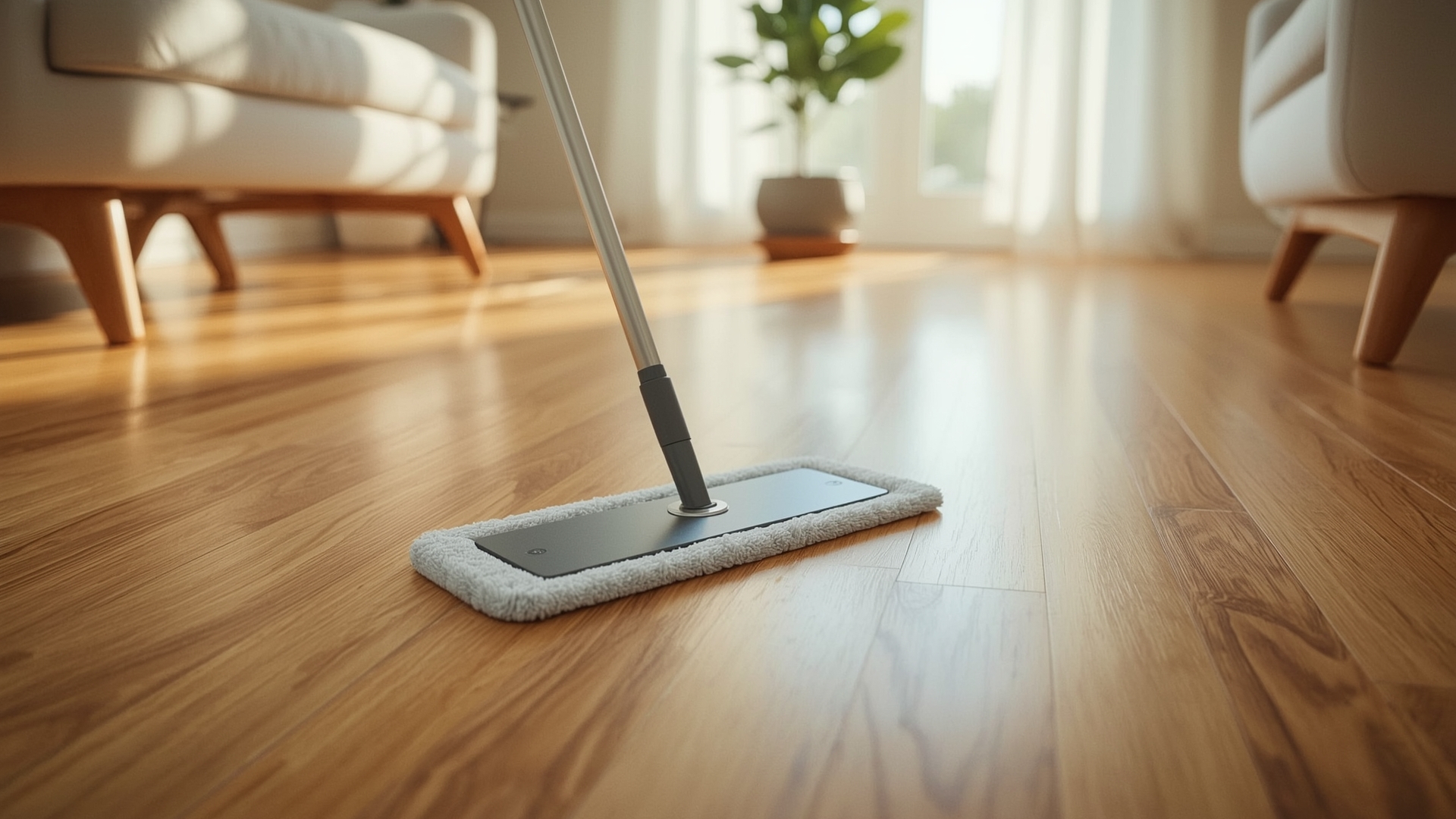
Hardwood floors scratch easily, swell from too much water, and show every streak. The mop you use matters more than most people realize. A flat mop with the right pad and the right design protects your floors instead of damaging them — and it makes cleaning faster.
This guide covers everything you need to pick the best flat mop for hardwood floors: pad materials, swivel mechanisms, wring systems, weight, and which brands hold up over time.
Key Takeaways
- Microfiber pads are the safest choice for hardwood because they trap dirt without scratching and release very little water.
- Spray mops work well for light daily cleaning, but a bucket-and-wring system gives you better moisture control for deeper passes.
- A 360-degree swivel head lets you clean under furniture without moving it or straining your back.
- Pad size matters: a 16-inch pad covers more floor per stroke, reducing cleaning time on large rooms.
- Avoid string mops and sponge mops on hardwood — both leave too much water behind, which can warp or stain wood over time.
- Washable pads save money and reduce waste compared to disposable pad systems.
What Makes a Flat Mop Safe for Hardwood Floors?

Quick Answer: A hardwood-safe flat mop uses a soft microfiber pad, releases minimal water, and has no rough plastic edges that contact the floor. These three features prevent scratching, warping, and water stains on wood surfaces.
Hardwood floors have two main enemies: abrasion and moisture. Any mop that drags grit across the surface can create fine scratches. Any mop that saturates the wood can cause boards to swell, cup, or discolor.
A safe flat mop keeps both threats under control. The pad material does most of the work. Soft microfiber fibers pick up dirt and dust without grinding it into the finish. A low-moisture design — whether that’s a spray system with a controlled nozzle or a well-wrung reusable pad — keeps the floor surface just damp, not wet.
The frame matters too. Plastic frames with exposed hard edges can dig into baseboards or nick the floor if the mop tips. A fully padded base with flush edges is the safer design.
Why String Mops and Sponge Mops Damage Hardwood
String mops hold far more water than wood floors can safely handle. When you mop with one, you’re pushing puddles across the floor — not cleaning it. Sponge mops have a similar problem: they release water unevenly and can leave standing pools in the grain lines between boards.
Flat mops with controlled-release pads sidestep both issues. The pad holds just enough moisture to clean without flooding the surface.
What Are the Best Pad Materials for Hardwood Floor Mops?
Quick Answer: Microfiber pads are the top choice for hardwood floors. They trap fine dust, require less cleaning solution, and hold less water than cotton or sponge alternatives. Split-fiber microfiber pads clean more thoroughly than loop-pile microfiber.
Not all mop pads are equal — even within the microfiber category. The weave structure and fiber thickness affect how well the pad cleans and how much moisture it deposits on the floor.
Microfiber Pad Types Compared
| Pad Type | Fiber Structure | Best For | Water Retention | Abrasion Risk |
|---|---|---|---|---|
| Split-fiber microfiber | Wedge-shaped split fibers | Daily dry and damp cleaning | Low (releases when wrung) | Very low |
| Loop-pile microfiber | Looped continuous fibers | Light damp mopping | Moderate | Low |
| Terry cloth microfiber | Dense terry weave | Scrubbing sticky residue | Moderate to high | Low to moderate |
| Cotton blend | Cotton and polyester mix | Deep cleaning tile (not ideal for wood) | High | Moderate |
| Disposable dry sheet | Non-woven synthetic | Quick dust pickup | Minimal | Very low |
Split-fiber microfiber is the strongest performer on hardwood. The wedge-shaped fibers create a physical hook-and-grab action that lifts fine particles without needing much pressure or cleaning solution.
How Do Flat Mop Designs Differ and Which Is Best for Wood?

Quick Answer: Flat mops come in three main designs: spray mops, bucket systems, and steam mops. Spray mops suit daily hardwood maintenance. Bucket systems offer better moisture control for weekly cleaning. Steam mops are generally not recommended for hardwood.
Spray Flat Mops
Spray mops have a built-in reservoir that mists cleaning solution directly onto the floor as you push. You control the spray with a trigger on the handle. This design keeps the pad damp rather than wet, which is exactly what hardwood needs.
The downside: the reservoir holds a limited amount of solution, usually 10 to 20 ounces. On large floors, you’ll refill it multiple times. Reservoir size varies by brand and directly affects how far you can clean before stopping.
Bucket System Flat Mops
Bucket system mops use a separate wringer bucket. You dip the pad, wring it through a press or spin mechanism, then mop. This gives you the most control over how wet the pad gets.
These systems also let you change cleaning solution mid-job, which matters when you’re cleaning a large space or dealing with a dirty floor. The tradeoff is setup time — you need a bucket, water, and solution before you start.
Steam Flat Mops on Hardwood: Why Most Experts Warn Against Them
Steam mops use heat and pressurized water vapor to sanitize floors. On sealed tile or stone, they work well. On hardwood, the combination of heat and moisture can damage the finish, raise the wood grain, or void your floor’s warranty.
Even floors described as “sealed” can be vulnerable if the finish is thin or worn. Most hardwood flooring manufacturers explicitly advise against steam mopping.
What Swivel and Frame Features Should You Look For?
Quick Answer: Look for a 360-degree pivoting swivel head, a low-profile frame that slides under furniture, and a flush padded base with no hard edges that contact the floor. These features reduce effort and minimize scratch risk.
The swivel mechanism is one of the most underrated features on a flat mop. A stiff-frame mop forces you to move furniture or crouch down to reach corners. A 360-degree swivel head rotates freely, letting you steer the pad into tight spaces without lifting the mop.
Frame Design Attributes That Matter
| Feature | What to Look For | Why It Matters for Hardwood |
|---|---|---|
| Swivel range | 360-degree rotation | Cleans under furniture, reduces floor contact at awkward angles |
| Frame profile height | Under 1 inch | Reaches under toe kicks, cabinet bases, and low furniture |
| Edge material | Fully padded or rubber-edged | Prevents frame contact with baseboard or floor finish |
| Pad attachment | Velcro loop (hook-and-loop) | Secure fit prevents pad shifting during use |
| Frame flexibility | Slight flex under pressure | Keeps full pad contact on uneven floor sections |
How Does Flat Mop Pad Size Affect Cleaning Efficiency?
Quick Answer: Larger pads (16 to 18 inches) cover more floor per stroke, which reduces cleaning time on open areas. Smaller pads (11 to 13 inches) maneuver better in tight spaces like bathrooms or hallways with many corners.
Pad width is a practical decision based on your floor layout. Open-plan living areas benefit from wider pads. A 16-inch pad covers roughly 25 percent more floor per stroke than a 12-inch pad, which adds up quickly on large rooms.
If your home has a lot of narrow hallways, closets, or rooms with clustered furniture, a smaller pad gives you better control. Some brands sell mop frames in multiple sizes and offer matching pad packs, so you can swap based on the area you’re cleaning.
Which Flat Mop Brands Perform Best on Hardwood Floors?
Quick Answer: O-Cedar, Bona, Rubbermaid Reveal, Bissell SpinWave, and Norwex are consistently rated for hardwood safety. Each offers microfiber pads, controlled moisture, and swivel heads — the core features hardwood requires.
Brand and Product Comparison: Flat Mops for Hardwood
| Brand / Model | Mop Type | Pad Material | Pad Size | Reservoir Size | Approx. Price | Pad Reusability |
|---|---|---|---|---|---|---|
| O-Cedar ProMist MAX | Spray flat mop | Microfiber (split-fiber) | 16 inches | 16 oz | $30–$40 | Machine washable, 100+ cycles |
| Bona Hardwood Floor Spray Mop | Spray flat mop | Microfiber (split-fiber) | 15 inches | 28 oz (refillable) | $40–$55 | Machine washable, 500+ cycles |
| Rubbermaid Reveal Spray Mop | Spray flat mop | Microfiber loop-pile | 11 inches | 22 oz | $25–$35 | Machine washable, 60+ cycles |
| Bissell SpinWave | Powered spin mop (flat pad) | Microfiber soft pad | Dual 7-inch pads | 28 oz | $80–$100 | Machine washable |
| Norwex Mop System | Bucket system | High-density microfiber | 16 inches | N/A (bucket) | $90–$130 | Machine washable, 500+ cycles |
| Swiffer WetJet Wood | Spray mop (disposable pads) | Absorbent non-woven pad | 10 inches | 42 oz (proprietary) | $30–$40 + pad cost | Disposable (single use) |
O-Cedar ProMist MAX
O-Cedar’s ProMist MAX is one of the most popular hardwood floor mops in the mid-range price bracket. The 360-degree swivel head, wide 16-inch pad, and machine-washable microfiber make it a strong all-rounder. The spray trigger is responsive without over-wetting the floor.
Bona Hardwood Floor Spray Mop
Bona is a hardwood-specific brand. Their spray mop comes pre-filled with a pH-neutral hardwood cleaner and uses a refillable 28-ounce reservoir. The pad is rated for 500-plus wash cycles, which means the upfront cost spreads over several years of use. Bona also sells dry sweeping pads that attach to the same frame.
Rubbermaid Reveal Spray Mop
The Rubbermaid Reveal is a strong budget option. Its smaller 11-inch pad limits efficiency on large floors, but the reusable microfiber pad and simple spray trigger make it reliable. It works well in smaller homes, apartments, or for spot cleaning.
Swiffer WetJet Wood
Swiffer’s WetJet Wood is designed for wood floors, but the ongoing cost of disposable pads adds up. Each pad is single-use, and the proprietary cleaning solution isn’t always compatible with all wood finishes. It’s convenient for quick daily wipe-downs but not a cost-effective primary cleaning tool.
How Should You Use a Flat Mop on Hardwood Floors Without Causing Damage?

Quick Answer: Always dry-dust before damp mopping, use a wrung-out pad that’s damp not wet, mop in the direction of the wood grain, and dry the floor within 60 seconds of mopping to prevent moisture absorption into the boards.
Step-by-Step: Safe Flat Mopping Routine for Hardwood
- Dry-sweep first. Use a dry microfiber pad or dust mop to collect loose dirt, dust, and hair. Skipping this step drags abrasive particles across the finish during damp mopping.
- Wring the pad until barely damp. If you squeeze the pad and more than a few drops fall, it’s too wet. The goal is a pad that feels cool and slightly moist, not dripping.
- Mop in the direction of the wood grain. This follows the board lines and prevents solution from pooling in grain grooves between boards.
- Use short overlapping strokes. Each pass should overlap the previous one by a few inches to avoid leaving dry streaks.
- Check the floor as you go. If the surface stays wet for more than 60 seconds after you pass over it, your pad is too wet. Wring it further or switch to a fresh pad.
- Let the floor air-dry completely before walking on it or replacing furniture.
What Cleaning Solutions Are Safe for Hardwood Floors?
The cleaning solution matters as much as the mop. Harsh chemicals strip wood finish over time. Vinegar — despite being popular — is acidic and can dull polyurethane finishes with repeated use.
| Cleaning Solution | pH Level | Safe for Hardwood? | Notes |
|---|---|---|---|
| Bona Hardwood Cleaner | ~7 (neutral) | Yes | Formulated specifically for wood finish |
| Diluted dish soap (1 tsp per gallon) | ~7–8 | Yes (minimal use) | Leaves residue if overused; rinse thoroughly |
| White vinegar and water | 2.4–3.4 (acidic) | No | Degrades polyurethane finish over time |
| Murphy Oil Soap | ~9–10 (alkaline) | Not for sealed floors | Can build up on finish; designed for unfinished or oiled wood |
| Plain warm water | 7 (neutral) | Yes (sparingly) | Safe for maintenance cleaning; no residue risk |
How Often Should You Mop Hardwood Floors?
Quick Answer: Damp mop hardwood floors once a week in high-traffic areas and every two weeks in lower-traffic rooms. Dry dust or sweep daily or every other day to prevent abrasive buildup that scratches the finish during mopping.
Over-mopping is a real risk with hardwood. More moisture, more often, means more potential for the wood to absorb water over time. A good rule: if the floor doesn’t look dirty, skip the damp mop and do a dry pass instead.
High-traffic zones near entryways, kitchens, and hallways pick up more grit from foot traffic and shoes. These areas need more frequent dry-dusting — sometimes daily — to protect the finish.
What Is the Difference Between a Flat Mop and a Spin Mop for Hardwood?
Quick Answer: Flat mops use a fixed rectangular pad and are ideal for hardwood because they distribute moisture evenly and stay low-profile. Spin mops use a round yarn or microfiber head that retains more water, making them better suited for tile than wood.
Spin mops have a dedicated following for tile cleaning because the spinning action wrings the mop head fast. The problem with hardwood is that even a “well-wrung” spin mop head holds more residual water than a flat pad pressed through a wringer. The round head shape also creates uneven pressure, which means some parts of the floor get wetter than others.
Flat mops distribute pressure across the entire pad surface. This even contact means consistent — and controllable — moisture delivery across every square inch you cover.
How Do You Care for Flat Mop Pads to Make Them Last?
Quick Answer: Machine wash microfiber mop pads in cold or warm water with a fragrance-free detergent. Never use fabric softener or bleach — both break down microfiber structure. Air-dry or tumble dry on low heat. Most pads last 100 to 500 wash cycles with proper care.
Fabric softener is the most common mistake people make with microfiber pads. It coats the split fibers with a waxy residue, which fills in the microscopic grooves that give microfiber its cleaning power. After a few washes with softener, the pad loses its ability to trap dirt and becomes just a damp cloth dragged across the floor.
Washing pads separately from lint-producing fabrics like towels also helps. Lint sticks to microfiber and can reduce performance and leave fibers behind on your floor.
Mop Pad Care by Material
| Pad Material | Wash Temp | Detergent Type | Fabric Softener | Dry Method | Avg. Lifespan |
|---|---|---|---|---|---|
| Split-fiber microfiber | Cold to 140°F max | Fragrance-free, no softener | Never | Air dry or low heat | 200–500 washes |
| Loop-pile microfiber | Cold to 140°F max | Fragrance-free, no softener | Never | Air dry or low heat | 100–300 washes |
| Terry cloth microfiber | Cold to 120°F max | Fragrance-free, no softener | Never | Air dry or low heat | 100–200 washes |
| Cotton blend | Up to 160°F | Standard detergent | Acceptable | Tumble dry medium | 50–100 washes |
Is a More Expensive Flat Mop Worth It for Hardwood?
Quick Answer: Mid-range mops priced between $30 and $60 offer the best value for most homeowners. Budget mops under $20 often have weaker swivel joints and thinner pads. Premium mops above $80 add durability and pad quality, but rarely clean better than a good mid-range model.
Price follows two things in mop quality: the pad material and the frame construction. A cheap mop with a thin pad and a plastic swivel that cracks after six months costs more in the long run than a $40 mop with a machine-washable pad that lasts three years.
The Bona and O-Cedar models in the $30 to $55 range hit a sweet spot. They use commercial-grade microfiber, solid aluminum or stainless-steel handles, and swivel joints built to flex without breaking. For most homeowners cleaning hardwood floors weekly, this range is entirely sufficient.
Frequently Asked Questions
Can I use a flat mop on engineered hardwood?
Yes. Engineered hardwood has a real wood veneer over a plywood core, and it responds the same way as solid hardwood to moisture. Use a damp — not wet — microfiber pad and the same caution you’d apply to solid wood floors. Engineered hardwood is slightly more moisture-tolerant but still vulnerable to standing water.
Do I need a special cleaning solution for my flat mop?
No special formula is required, but pH-neutral cleaners are the safest choice. Products like Bona Hardwood Cleaner are formulated to clean without stripping finish. Plain warm water works for light cleaning passes and leaves no residue risk.
How do I stop my flat mop from leaving streaks on hardwood?
Streaks usually mean one of two things: the pad is too wet, or you’re using too much cleaning solution. Wring the pad until it’s barely damp and dilute any cleaning product to the recommended ratio. Using a dry finishing pass at the end of each row also removes solution residue before it dries.
Can a flat mop replace a vacuum on hardwood?
A dry microfiber flat mop can replace a vacuum for surface dust and light debris. It won’t pull dirt from gaps between boards the way a vacuum with a hardwood attachment does. For a thorough clean, use a vacuum first to remove deep debris, then follow with the flat mop.
How long do flat mop handles last?
Stainless steel and aluminum handles typically last 5 to 10 years with normal household use. Plastic handles in budget mops may crack at the swivel joint within 1 to 2 years, especially under side pressure when maneuvering around furniture. Handle material is one area where spending a little more pays off.
Are disposable mop pads bad for hardwood floors?
Disposable pads aren’t inherently damaging, but they offer less cleaning power than split-fiber microfiber and create ongoing waste and cost. Some disposable pads — particularly dry electrostatic sheets — are useful for quick dust pickup. For full cleaning sessions, reusable microfiber pads outperform disposables on hardwood in both safety and effectiveness.